
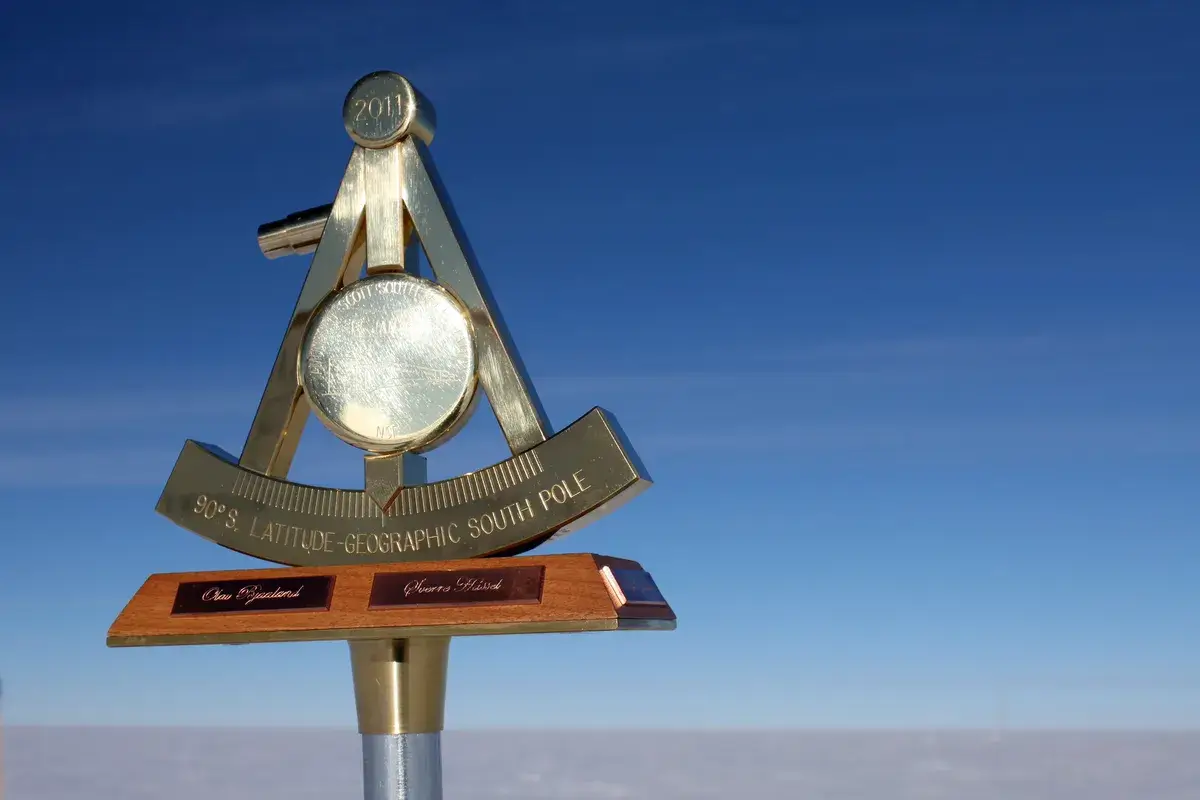

Every year on 1 January, the scientists at the Amundsen-Scott Station in Antarctica move the marker of the geographic South Pole by about 10 metres. It’s not the Earth’s magnetic field that’s the problem, it’s the movement of the ice sheet the station is on. It’s slowly drifting towards the Weddell Sea at a rate of about 10 metres per year. The South Pole is still the same spot where the Earth’s axis of rotation meets the surface, but the ice sheet under it is always moving. There’s no solid ground at the North Pole, just floating sea ice above the ocean.
New Year’s celebrations in Antarctica are a bit different: in the relentless summer light and severe cold, an international team at the southernmost point of the planet takes part in an unusual but important annual ritual, as IFLScience writes.
Every year, on 1 January, the team at the Amundsen-Scott Station at the South Pole get together to move the pole made of ice that marks the geographic South Pole. It’s worth mentioning that the station is run by the US Antarctic Program and is located deep in the interior of Antarctica. It’s at 90° south latitude, at the geographic South Pole, on an ice sheet about 2,835 metres above sea level.
It’s interesting to note that the annual pole shift at the station isn’t actually due to the shift of the planet’s magnetic pole. Researchers say the ritual is necessary because the ice sheets are always moving, a bit like thick syrup.
The geographic South Pole is a fixed point where the Earth’s axis of rotation meets the surface. But it’s on a glacier that’s slowly moving. This ice is moving quickly towards the Weddell Sea near the Amundsen-Scott station at the South Pole. This steady movement displaces both the station and the ground marker at a rate of about 10 metres per year.
So, every year on New Year’s Day, the scientists do a survey of the area and put up a new marker. The old pole marker has been taken away, and the new one has been put up during a little ceremony with a few scientists, technicians and support staff who are working at the pole for the summer.
It’s interesting that there isn’t a problem like this anywhere else in the world, like at the North Pole. The truth is, there’s no solid ground here. The North Pole of the Earth is in the middle of the Arctic Ocean, and it’s covered in sea ice that’s always cracking, reforming and drifting because of the wind and currents.
Researchers say that the geographic and magnetic poles of the Earth shouldn’t be confused. The latter move independently of the North and South geographic poles. For instance, the magnetic South Pole is currently drifting northwest at a speed of about 55 kilometres per year.