
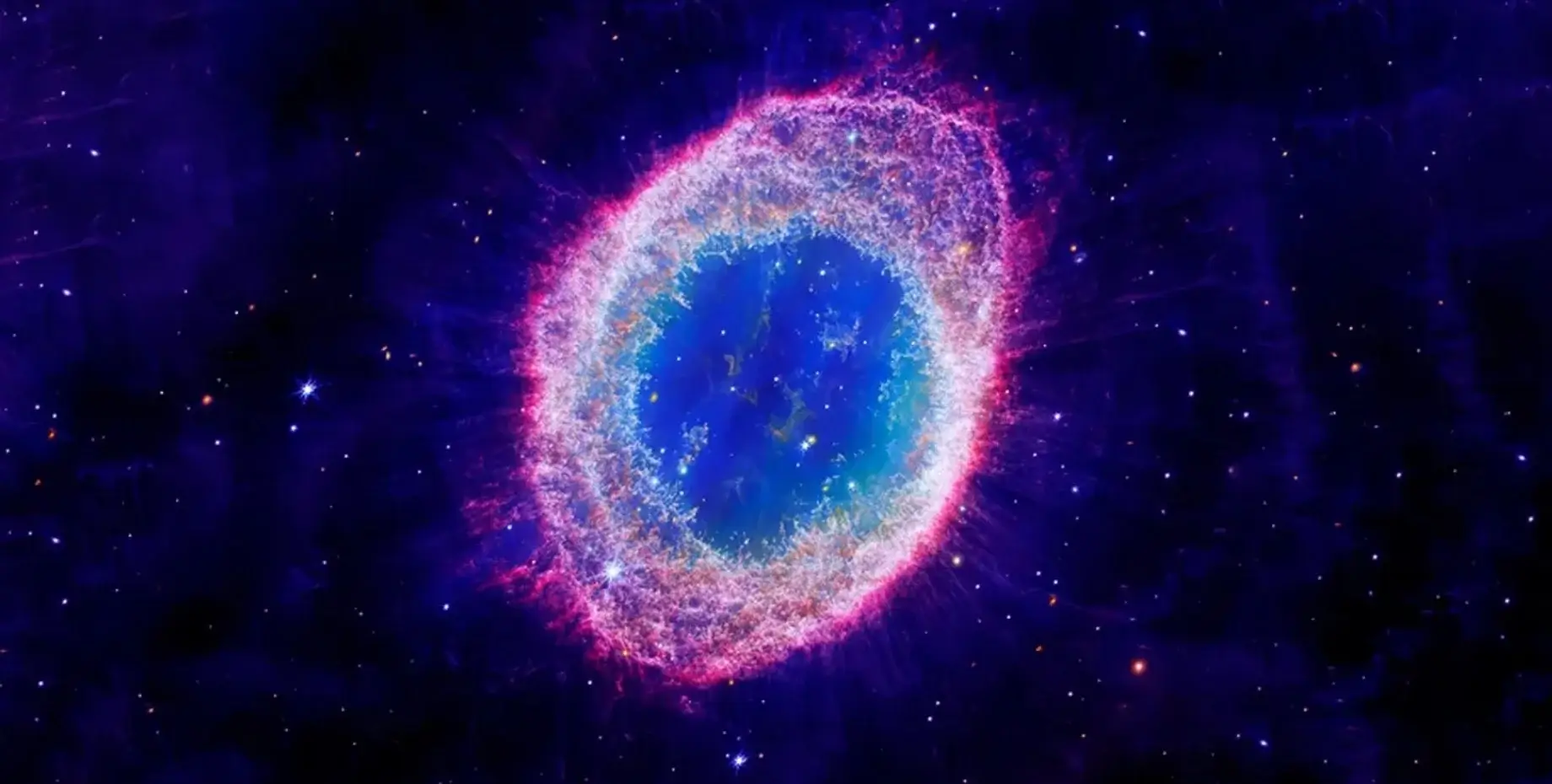

Michael Gillen – who used to be a physicist at Harvard – reckons that God might be about 439 billion trillion kilometres away from Earth. That’s the distance from the cosmic horizon, which is basically the edge of the observable universe. The scientist says that what the Bible says about paradise can be linked to the idea of the cosmic horizon, and that there might be a place where time doesn’t exist and ‘light-like entities’ live. But the scientific community doesn’t accept these claims. They say that the cosmic horizon isn’t a physical place, but depends on the observer. Gillien’s statements are more than just science – they’re a philosophical argument that mixes religion with cosmology.
Michael Gillen, a former Harvard physicist, says there might be a God-sized hole in the universe. Sadly, if you’re hoping to have a chat with God, the scientist says he’s about 439 billion trillion kilometres away. First off, just to be clear, this is only a hypothesis, not science. Guillen mixes Christian Bible passages about God with a physical concept called the cosmic horizon to support his argument about where God might be, writes IFLScience.
The universe is expanding
We can only see light from deep space that’s reached Earth. So basically, there’s a limit to how much of the universe we can actually see. This is known as the observable universe. If the universe didn’t change in size, i.e. if it was static, the only thing stopping us from seeing very distant objects in space would be the time it takes for light to reach Earth.
If the universe was static, over time we would detect more and more light from distant objects, and the cosmic horizon – the area of the universe that we can observe – would get bigger. At some point in the distant future, the rest of the universe will become observable.
But our universe isn’t static, it’s expanding. This means that over time, we’ll see less and less of the universe, and more distant objects will stay forever out of our sight.
Hubble’s law says that objects that are farther away are moving away from us faster than closer ones, because space is always expanding.
The physicist says God’s there
Guillén says this is where it gets really interesting. Basically, a galaxy about 439 billion trillion kilometres away from us will be moving at 300,000 km/s, which is the speed of light. This distance is called the cosmic horizon. So, as Einstein explained in his theory of relativity, only light can travel at the speed of light. This means that we will never be able to reach the cosmic horizon. So, it’s quite possible that paradise and God are on the other side of the cosmic horizon, as Guillén says.
We’ll never be able to see light from the other side of the cosmic horizon because the universe is expanding so fast that light can’t keep up. Guillén also says that the Bible says heaven is probably full of immortal, non-physical beings. He links this, albeit indirectly, to the cosmic horizon.
Guillén says that most people nowadays think there’s a whole other universe just beyond the cosmic horizon. But we’ll never be able to see it because we’ll never be able to reach the cosmic horizon.
The physicist also says that looking at the cosmos and Einstein’s special and general theories of relativity show that time stops at the cosmic horizon. There’s no past, present or future there. But, unlike time, space exists at the cosmic horizon and beyond it. This means that the hidden universe beyond the cosmic horizon is probably not inhabitable, and there may be light and light-like entities there.
The cosmic horizon isn’t a physical place, it’s more like a concept
But actually, scientists don’t see the cosmic horizon like that. We think that time doesn’t stop at the cosmic horizon. Light that’s right behind this horizon would take a long time to reach Earth, but it would get here in the end, just with a strong red shift. Because the universe is expanding, this event, whatever it is, seems to take longer to us because the light is stretched when it reaches us.
The thing about cosmic horizons is that they depend on the observer. They’re not physical locations in the universe. We’re on the cosmic horizon of some place or some extraterrestrial civilisation, and yet time doesn’t stop for us, and as far as we know, we’re not gods to aliens.
But Gillian reckons that everything beyond the cosmic horizon could have come before the universe even appeared, which means that the creator of the universe could be out there. Gillian’s statements about God go beyond the scope of science because the cosmological model he uses is incorrect. It considers the boundary of the observable universe to be a physical place.