
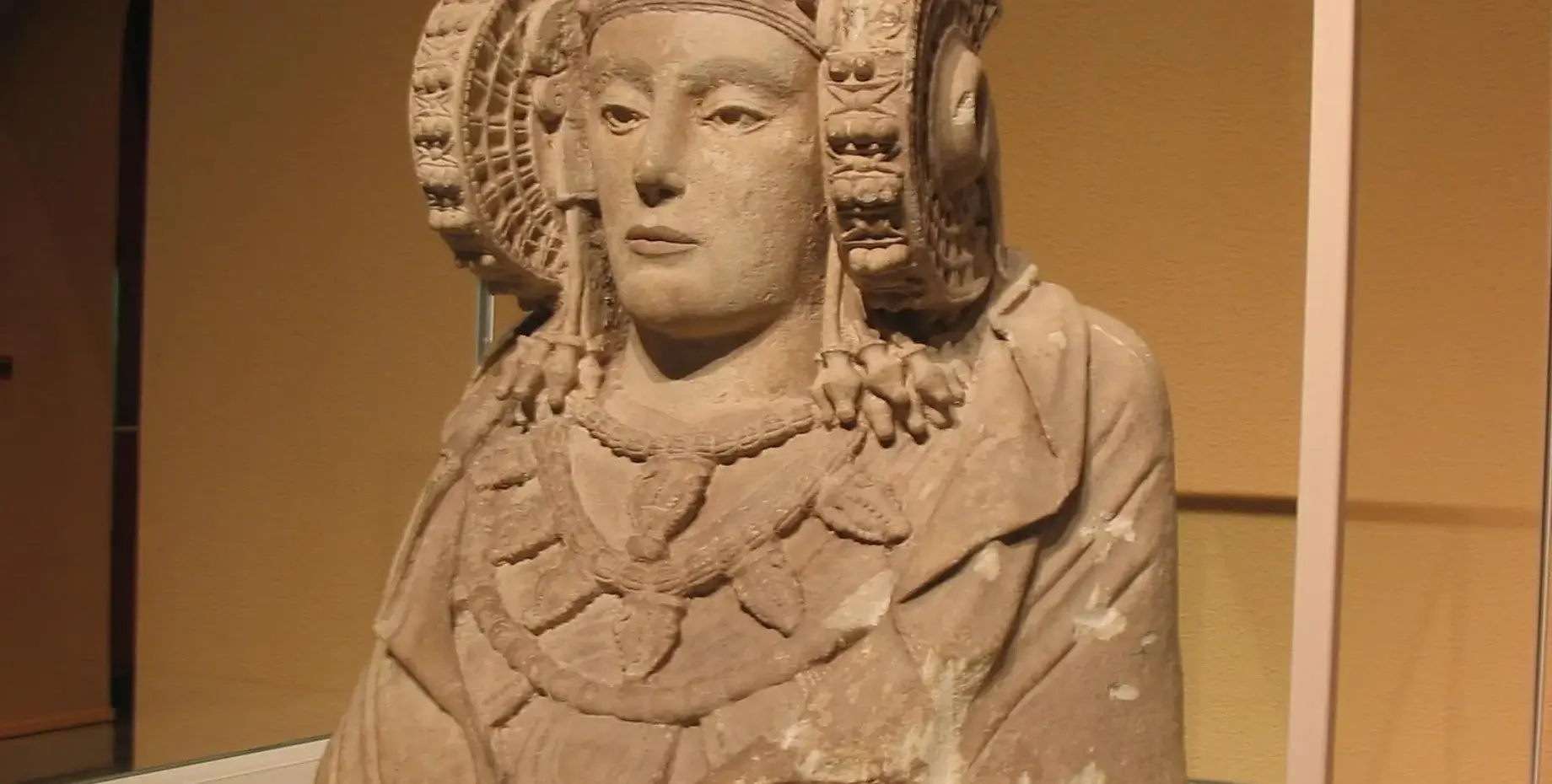

The Lady of Elche is a special sculpture made of limestone. It was found in Spain in 1897. The bust is striking because it has detailed clothing, luxurious jewellery and a mysterious cavity in the back, which probably served to store ashes. Even though some people thought it might be fake, science has shown that the artefact is real. People still don’t know for sure whether the sculpture shows the Carthaginian goddess Tanit or an important person from ancient Spain who was thought to be a god. This amazing ancient artwork is kept in Madrid, and it shows how people from different cultures shared ideas in the ancient Mediterranean world.
At the end of the 19th century, an unexpected archaeological find on the Mediterranean coast of Spain started a debate that lasted more than 100 years. The limestone sculpture, later named ‘The Lady of Elche’, is one of the most famous examples of ancient Iberian art. In the summer of 1897, a farmer working near Elche found a life-size painted bust of a woman. The French archaeologist Pierre Paris then bought the sculpture and took it to the Louvre in Paris, according to Live Science.
The artefact was kept in France for decades, and during World War II, the bust was returned to Spain. It is now kept in the National Archaeological Museum in Madrid.
The Lady of Elche is 56 centimetres tall and weighs just over 65 kilograms. The bust is made from limestone and shows a woman wearing fancy clothes. She wears a pointed tiara and a diadem on her forehead, partially covered by a veil. The headdress ends with large rosettes near the ears.
The cloak, fastened with a small pin, is unbuttoned at the front, revealing three necklaces decorated with amulets. Earrings and ribbons frame her face, and you can still see traces of the original paint on her lips and clothing.
One of the most interesting things about it is a large hole carved into the back of the sculpture. Experts think that this hole might have been used to hold the ashes of a person who was burned. Later scientific research confirmed that the ashes found inside were ancient, confirming the theory that the bust had a ritual purpose.
People have had different opinions about the sculpture’s artistic style. It combines influences from the Iberian Peninsula, Greece and North Africa. Because of this combination, some experts once claimed that it was a fake.
In a book from 1995, art expert John F. Moffitt said that the bust might have been made in the late 19th century by Spanish artist Francisco Pallas y Puig, who was known for copying other people’s art. However, scientific analysis of the pigments showed that they were ancient. After looking at the sculpture more closely, experts decided that it is over 2,400 years old.
Even though we know how old the artefact is, there are still a lot of questions. Scientists still can’t agree on whether the Lady of Elche was originally a freestanding bust or part of a larger, full-length statue. We don’t know who she is.
Some researchers think she is connected to Tanit, the most important goddess of ancient Carthage. This suggests that there were religious connections between the cultures of Iberia and Punic. However, the National Archaeological Museum says that ‘no one knows who the figure is.’ The museum also says that ‘recently, she has been seen as a noble lady from the Iberian Peninsula who was worshipped by her descendants.’
The Lady of Elche shows the cultural exchanges that shaped ancient Spain. The fact that we keep finding new things about it, the fact that we keep studying it scientifically, and the fact that people keep discussing it show how archaeology helps us to understand the past better. More than 100 years after it was found, the sculpture still makes us ask new questions about art, belief and identity in the ancient Mediterranean.